
Procedural skills family medicine: competency
The family physician who graduates residency and opens a practice in a rural community where the nearest obstetrician is ninety minutes away discovers within the first week that knowing how to manage a pregnancy is not the same as knowing how to deliver a baby. The physician who joins a community health center where dermatology referrals take four months learns that distinguishing a benign nevus from a suspicious lesion is academic knowledge — but performing a shave biopsy is a procedural skill that requires trained hands, not just a trained mind. Family medicine occupies a unique space in the medical training landscape: it is the only specialty where the scope of practice is not defined by an organ system or an age group but by the needs of the community the physician serves — and those needs include procedures. What procedures a resident learns, how those procedures are taught, how competency is measured, and what happens when a resident cannot reach competence are questions that shape the daily reality of every family medicine training program in the country.
The philosophy behind procedural training in family medicine
Family medicine is not a procedural specialty in the way that surgery or interventional cardiology is — no one enters family medicine to operate. But the specialty's defining commitment to comprehensive, community-based care means that the family physician is often the only physician available to perform procedures that in urban settings are referred to specialists. The family doctor who cannot place an IUD, remove a sebaceous cyst, repair a simple laceration, or perform a joint injection sends every patient to a specialist — and in many communities, that specialist does not exist or has a months-long wait list.
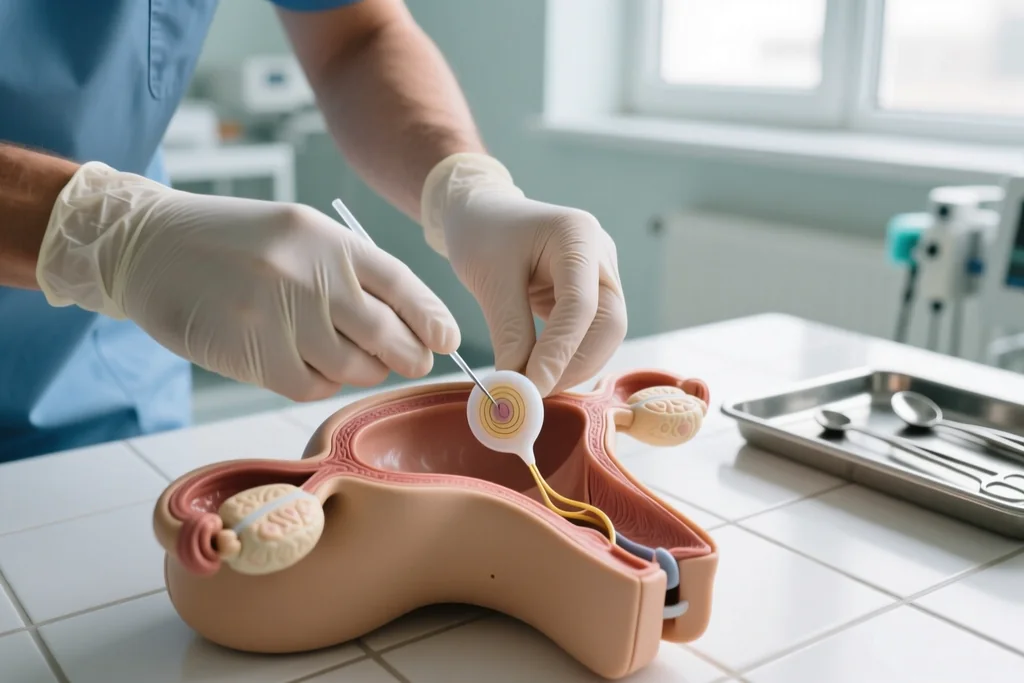
The philosophy of procedural training in family medicine is therefore pragmatic, not aspirational. Programs are not trying to produce physicians who can perform every procedure in every situation; they are trying to produce physicians who can safely perform the procedures that their patients are likely to need, who know when to refer when a procedure exceeds their skill, and who can manage complications when things go wrong. This balance — competence with humility — is the core of procedural training in the specialty.
The Accreditation Council for Graduate Medical Education (ACGME) requires family medicine programs to ensure that residents develop competence in a defined set of procedures, but the specific list is determined by each program based on its patient population, faculty expertise, and community needs. A program in rural Montana will emphasize obstetrics, cesarean sections, and emergency procedures; a program in urban Chicago may de-emphasize obstetrics and focus on office-based procedures like skin biopsies, joint injections, and contraception management. This flexibility is intentional — it reflects the reality that family medicine is not a single specialty with a single practice pattern, but a family of practices adapted to different settings.
The core procedures every family medicine resident should learn
Despite the flexibility in program-specific procedural emphasis, a set of core procedures has emerged as essential for all family medicine residents — regardless of practice setting. These procedures share three characteristics: they are commonly needed in outpatient primary care, they can be safely performed in an office setting, and they have a body of evidence supporting their performance by family physicians.
The core procedures can be grouped into several categories that reflect the breadth of family practice. Skin and soft tissue procedures include shave biopsy, punch biopsy, excisional biopsy of small lesions, cryotherapy, incision and drainage of abscesses, and simple laceration repair with suturing. Women's health procedures include intrauterine device insertion and removal, subdermal contraceptive implant insertion and removal, endometrial biopsy, and cervical biopsy with colposcopy in some programs. Musculoskeletal procedures include joint injections (intra-articular and soft tissue), trigger point injections, and fracture and dislocation reduction in programs with emergency or sports medicine emphasis. Office-based diagnostics include flexible sigmoidoscopy, nasopharyngoscopy, and audiometry in some programs. Obstetric procedures — offered by programs with maternity care tracks — include normal vaginal delivery, episiotomy repair, vacuum-assisted delivery, and cesarean section in some rural tracks.
Not every resident will perform every procedure. The ACGME allows programs to define which procedures are required for graduation and which are elective. A resident who plans to practice in a setting without obstetrics may not be required to demonstrate competency in vacuum delivery, but they must be exposed to the procedure and understand the indications, contraindications, and complications. The principle is exposure for all and competency for those who will perform the procedure independently.
How procedural skills are taught: the progression from simulation to patient care
Procedural training in family medicine follows a deliberate progression that moves from low-fidelity to high-fidelity learning environments, building competence in stages before the resident ever touches a patient. This progression is grounded in educational theory — specifically, the concept of deliberate practice, where skills are broken down into components, each component is practiced to mastery, and the components are integrated into the full procedure.
The first stage is didactic preparation. Before performing a procedure, the resident studies the anatomy, indications, contraindications, technique, and complications. This knowledge is assessed through written tests, oral questioning, or case-based discussions. The resident must understand not only how to perform the procedure but when to perform it, when not to perform it, and what to do when a complication occurs. This knowledge base is the foundation — without it, the hands are dangerous.
The second stage is simulation. The resident practices the procedure on a model — a task trainer, a manikin, or a cadaver — under faculty supervision. Simulation allows the resident to make mistakes in a safe environment, repeat steps until muscle memory develops, and receive immediate feedback without risk to a patient. The quality of simulation varies: a pig's foot for suturing practice is low-fidelity but effective for learning basic knot-tying and tissue handling; a high-fidelity birthing simulator with realistic tissue response and vital sign monitoring is expensive but allows practice of obstetric emergencies.
The third stage is supervised performance on patients. The resident performs the procedure on a real patient under direct faculty observation — the attending is in the room, watching every step, ready to intervene. The number of supervised performances required before independent practice varies by procedure and by resident learning speed. For a simple procedure like shave biopsy, two or three supervised performances may suffice. For a complex procedure like IUD insertion, five to ten may be needed.
The fourth stage is indirect supervision. The resident performs the procedure with the attending available but not in the room — the attending can be called if needed, but the resident is functioning independently. This stage is the transition to practice, and it is where the resident develops the confidence and efficiency that independent performance requires.
Competency assessment: beyond counting numbers
For decades, procedural competency in residency was assessed by a single metric: the number of times the resident performed the procedure. The assumption was that repetition produced competence — perform ten joint injections and you are competent. This assumption is flawed. A resident who performs ten procedures poorly is not competent; a resident who performs five procedures with excellent technique is. The shift from volume-based to competency-based assessment is one of the most significant changes in graduate medical education in the past decade.
The ACGME now requires programs to assess procedural competency through direct observation using validated tools — not just logbook counts. The assessment evaluates the resident's performance across multiple dimensions: preparation (did the resident obtain consent, position the patient, prepare the equipment?), technique (was the procedure performed correctly and safely?), communication (did the resident explain the procedure to the patient and address concerns?), and post-procedure care (did the resident provide appropriate aftercare instructions and follow-up planning?).
The most widely used direct observation tool is the mini-CEX (mini Clinical Evaluation Exercise), adapted for procedural assessment. The faculty member observes the resident performing the procedure and rates each dimension on a scale — typically 1 to 9, with anchors for each level. The assessment includes qualitative feedback — specific comments on what the resident did well and what needs improvement. This feedback is the formative element that drives learning; the numeric rating is the summative element that documents competence.
Competency is not declared after a single successful observation. The ACGME requires multiple observations across the training period to establish a consistent pattern of competence. A resident who performs a procedure perfectly once but poorly the next time has not demonstrated competence — they have demonstrated variability, which is the enemy of safe practice. The goal is consistent, reproducible performance across different patients, different clinical settings, and different levels of complexity.
The assessment tools programs use to evaluate procedural skills
Different programs use different tools to assess procedural competency, and each tool has strengths and limitations. Understanding the available tools helps residents and faculty choose the right assessment for the right stage of learning.
To compare the most commonly used procedural assessment tools in family medicine training, it helps to examine how each one works, what it measures, and where its limitations lie.
| Assessment tool | How it works | What it measures | Strengths | Limitations |
|---|---|---|---|---|
| Procedure logbook | Resident records each procedure performed | Volume and variety of experience | Simple, easy to track, provides documentation | Does not assess quality; high count does not equal competence |
| Direct observation (mini-CEX) | Faculty observes procedure and rates performance on structured form | Technique, communication, preparation, post-procedure care | Validated, provides qualitative feedback, assesses real performance | Time-consuming for faculty; depends on observer skill |
| Simulation-based assessment | Resident performs procedure on model; scored against checklist | Technical skill without patient variability | Standardized, repeatable, safe environment | May not transfer to real patient complexity |
| OSCE (objective structured clinical exam) | Resident rotates through stations with standardized patients or models | Integrated performance under time pressure | Comprehensive, standardized across residents | Resource-intensive; limited number of stations per exam |
| Entrustment rating | Faculty rates how much supervision the resident needs | Readiness for independent practice | Directly addresses the question of autonomy | Subjective; requires faculty who know the resident well |
| Self-assessment | Resident rates own competence on each procedure | Self-awareness and perceived gaps | Promotes reflection; quick to administer | Residents often overestimate or underestimate own skill |
| Patient outcome tracking | Program tracks complications and outcomes for procedures performed by residents | Safety and quality of care | Real-world impact data | Confounded by patient factors; small numbers per resident |
No single tool provides a complete picture of procedural competence. The strongest programs use a combination — logbook for volume tracking, direct observation for quality assessment, simulation for early-stage learning, and entrustment ratings for the transition to independent practice. The combination is what builds the evidence trail that the resident is ready to perform procedures unsupervised after graduation.
The ACGME milestones and procedural competence
The ACGME milestones provide the framework within which procedural competency is tracked and reported. Each specialty has its own set of milestones — competency-based milestones that describe the expected progression from novice to expert across the training period. Family medicine milestones include a specific sub-competency for procedural skills that describes the expected performance at each level.
The milestones are assessed semi-annually by the clinical competency committee (CCC) — a group of faculty members who review all available assessment data for each resident and assign a milestone level. The CCC considers direct observation scores, logbook data, simulation performance, self-assessments, patient outcomes, and faculty opinions to arrive at a global judgment of where the resident falls on the developmental progression.
The progression for procedural skills typically follows a pattern. In PGY-1, the resident is expected to perform basic procedures under direct supervision — simple suturing, cryotherapy, skin biopsies — with the attending in the room. By mid-PGY-2, the resident should be performing these procedures with indirect supervision and beginning to tackle more complex procedures like IUD insertion and joint injections under direct supervision. By PGY-3, the resident should be performing the full range of required procedures with indirect supervision and should be approaching independent practice — the attending is available but not needed unless a complication arises.
The milestone framework is designed to identify residents who are not progressing as expected. A PGY-3 resident who is still at the PGY-1 level for procedural skills triggers a CCC review — not as a punitive measure, but as an intervention to understand why the progression is stalled and what support the resident needs. The causes range from insufficient procedural volume (the program does not have enough cases) to anxiety that interferes with performance to a genuine skill deficit that requires additional training.
The challenge of procedural volume: enough cases to learn
One of the persistent challenges in family medicine procedural training is ensuring that residents have enough cases to develop competence. A resident who needs to perform ten IUD insertions to reach competence but whose clinic sees only three IUD patients per month may not reach the required volume by graduation. This problem is particularly acute for less common procedures — fracture reduction, flex sig, cesarean section — where the patient volume in any single program may be insufficient.
Programs address this challenge through several strategies. Procedural workshops — concentrated sessions where residents practice multiple procedures on simulators over a day or weekend — supplement clinical volume with simulated experience. Rotations at high-volume sites — sending residents to a family medicine clinic that specializes in women's health for a month to get concentrated IUD experience — provide focused exposure. Interprogram collaborations — two or more programs sharing procedural training resources — expand the case pool. Procedural electives — allowing residents to spend elective time at sites with high procedural volume — give motivated residents the opportunity to exceed minimum requirements.
The challenge of volume is not just about numbers; it is about the quality of the experience. Ten joint injections performed on straightforward knee effusions in healthy patients do not prepare the resident for the difficult injection in an obese patient with osteoarthritis and anatomic distortion. Programs must ensure that residents encounter a range of complexity — not just the easy cases that build confidence but the difficult cases that build judgment.
When a resident struggles: remediation and support
Not every resident reaches procedural competence on the same timeline, and some residents genuinely struggle with the hands-on aspects of medical practice. A resident who excels in medical knowledge and clinical reasoning but who cannot master suturing technique is not uncommon — and the response to this struggle must be supportive, not punitive.
The first step in addressing procedural difficulty is identifying the specific barrier. Is the problem knowledge-based (the resident does not understand the anatomy or technique), psychomotor (the resident's hands lack the dexterity or coordination), confidence-based (the resident understands and can perform but freezes under pressure), or volume-based (the resident has not had enough practice)? Each barrier requires a different intervention.
For knowledge-based barriers, focused didactic sessions with faculty can address the gap. For psychomotor barriers, additional simulation practice with task trainers — repeating the procedure on models until the motor pattern becomes automatic — is the primary intervention. For confidence-based barriers, a graded exposure approach — starting with the simplest version of the procedure and gradually increasing complexity — builds comfort. For volume-based barriers, the program needs to create additional procedural opportunities — workshops, electives, or rotations at high-volume sites.
Remediation is not a label — it is a process. The resident who needs extra time and practice to reach competence is not a failure; they are a learner who requires a different pathway. The program that frames remediation as support rather than punishment creates an environment where residents are willing to ask for help — and that willingness is what prevents the far more serious outcome of a resident graduating without the skills they need.
The role of simulation: what models can and cannot teach
Simulation has become a central component of procedural training in family medicine — and for good reason. The ability to practice a procedure repeatedly without risk to a patient, with immediate feedback, and in a controlled environment accelerates the early stages of learning. But simulation has limits that programs and residents must understand.
What simulation teaches well is the motor pattern — the physical sequence of movements that constitutes the procedure. A resident who has practiced IUD insertion on a pelvic model twenty times has developed the hand movements needed to pass the uterine sound, load the IUD, and insert the device. This motor learning is real and transfers to the clinical setting.
What simulation does not teach is the variability of real patients — the patient who is anxious and tense, the cervix that is difficult to visualize, the uterus that is retroverted, the bleeding that obscures the field. These variables are what make real procedures harder than simulated ones, and they can only be learned through supervised patient experience.
The optimal approach uses simulation as a prelude to patient care, not a replacement. The resident who practices on a model until the motor pattern is automatic, then performs the procedure on a patient under supervision, learns both the technique and the adaptation to real-world conditions. The resident who skips simulation and goes straight to patient care learns more slowly, with more mistakes, and with more patient discomfort. The resident who only simulates and never transitions to patient care develops false confidence that shatters at the first real encounter.
Procedures by practice setting: what changes after graduation
The procedures a family physician performs after graduation depend almost entirely on practice setting — and this reality should inform which procedures a resident prioritizes during training. A resident entering a rural practice with no obstetrician within fifty miles needs competency in normal vaginal delivery, episiotomy repair, and basic emergency obstetric procedures. A resident entering an urban group practice with a nurse practitioner partner and a referral network of specialists may never deliver a baby but will perform skin biopsies, joint injections, and IUD insertions weekly.
Residents should approach procedural training with their career goals in mind — but with the awareness that goals change. The resident who plans to do obstetrics in residency but changes career direction in PGY-2 benefits from having developed the broader procedural skills that transfer across settings. Suturing, biopsy technique, and joint injection are procedures that are valuable in almost every practice setting; cesarean section and fracture reduction are valuable only in specific settings.
Several principles guide the selection and prioritization of procedural skills during residency training, and residents should consider these when planning their procedural learning.
Before selecting which procedures to focus on during residency, residents should weigh several factors that influence the long-term value of each procedural skill.
Principles for prioritizing procedural skills during family medicine residency:
- Match procedures to anticipated practice setting — a resident planning rural practice should prioritize obstetrics, emergency procedures, and fracture management; a resident planning urban outpatient practice should prioritize office-based procedures like biopsies, injections, and contraception.
- Prioritize transferable skills — suturing, local anesthesia, and sterile technique underpin multiple procedures. Mastering these fundamentals makes learning any new procedure faster.
- Learn the complication management, not just the procedure — every procedure has potential complications. A resident who can perform an IUD insertion but cannot manage a vasovagal reaction, a perforation, or a lost string is not fully competent.
- Develop the judgment to refer — competence includes knowing when not to perform a procedure. A resident who attempts to remove a complex cyst that should be referred to surgery has not developed the judgment that defines true competence.
- Document everything — maintain a detailed procedure log with dates, types, supervision levels, and outcomes. This log is the evidence trail that supports hospital credentialing after graduation.
- Seek feedback after every procedure — even a well-performed procedure has elements that can improve. The resident who asks "what could I have done better?" after every procedure accelerates their learning curve.
- Practice beyond minimum requirements — the minimum number of supervised procedures for competency is a floor, not a ceiling. Residents who exceed minimums develop deeper competence and greater confidence.
- Plan for maintenance after graduation — procedural skills decay without practice. Residents should develop a plan for maintaining skills they intend to use in practice, including identifying continuing education opportunities and procedural refresher courses.
These principles transform procedural training from a checklist of requirements into a strategic approach to building the skill set that will define the resident's practice after graduation. The resident who thinks deliberately about which procedures to master — and why — enters practice better prepared than the resident who simply completes the minimum requirements.
The credentialing bridge: from residency competence to hospital privileges
Procedural competence in residency does not automatically translate to procedural privileges after graduation. Hospitals and health systems require evidence of training and competence before granting privileges to perform procedures — and the evidence they require is increasingly rigorous.
The procedure log maintained during residency is the primary document supporting credentialing applications. Hospitals typically ask for documentation of the number of procedures performed, the level of supervision, and any complications. A resident who graduates with a logbook showing fifty skin biopsies, twenty IUD insertions, and fifteen joint injections — each documented with date, supervision level, and outcome — has strong evidence to support a credentialing application. A resident who graduates with a sparse or incomplete log faces a more difficult process.
Some procedures require more than logbook evidence. Hospitals may require completion of a procedural course, a period of proctoring (where a physician observes the new hire performing the procedure before granting independent privileges), or a minimum annual volume to maintain privileges. These requirements vary by institution and by procedure — and residents should understand them before graduation so they can plan their post-residency credentialing strategy.
Teaching procedures to the next generation
Many family physicians who develop strong procedural skills in residency find themselves teaching those skills to medical students and junior residents — and teaching a procedure is a different skill from performing one. The physician who can place an IUD flawlessly but cannot explain the steps to a learner is not an effective teacher.
Effective procedural teaching follows a structured approach that mirrors the learning progression. The teacher first demonstrates the procedure at normal speed, then breaks it down into steps with explanation, then watches the learner perform it with coaching, and finally allows independent performance with feedback. This approach — see one, do one, teach one — is a caricature of procedural teaching that has been largely replaced by the more structured see several, do several with supervision, teach with supervision model.
The ability to teach procedures is a competency that family medicine programs increasingly assess. Residents who teach medical students during procedural workshops are evaluated on their ability to explain, demonstrate, and provide feedback — and this assessment feeds into the ACGME milestone for teaching, which is a separate sub-competency from procedural skills.
The evolving scope of family medicine procedures
The scope of procedures performed by family physicians is not static. New procedures enter the scope as evidence accumulates and training evolves; old procedures exit as they are replaced by better alternatives or as specialist access improves. Point-of-care ultrasound — once a tool for emergency medicine and radiology — is increasingly incorporated into family medicine training as a diagnostic extension of the physical exam. Medication-assisted treatment for opioid use disorder — once the domain of addiction specialists — is now a core competency for many family medicine programs. Skin biopsy techniques continue to evolve with new tools and guidelines.
The physician who graduates residency with a fixed set of procedural skills and never learns a new one is not keeping up with the specialty. The most important procedural skill is the ability to learn new procedures — to study the evidence, practice under supervision, seek feedback, and integrate the new skill into practice safely. This meta-skill is what the best procedural training programs develop: not just competence in today's procedures, but the capacity to acquire tomorrow's.
Conclusion: competence is a journey, not a destination
Procedural skills in family medicine are not a graduation requirement to be checked off and forgotten — they are a professional commitment that begins in residency and continues throughout a career. The resident who develops strong fundamentals, learns to assess their own competence honestly, and builds the habit of seeking feedback and improvement will carry those skills into practice and refine them over decades. The program that teaches procedures with rigor, assesses them with multiple tools, and supports residents through the inevitable struggles produces physicians who are not just competent on paper but confident in the room — the room where a patient is waiting, the local anesthetic is wearing off, and the physician's hands need to know what to do.